
Payroll taxes in Texas are simpler than in most states, mainly because Texas has no state income tax. But you still have real federal obligations, a state unemployment tax, and a calendar of deadlines to keep. This guide is a practical 2026 reference for Texas small business owners. It walks through federal and state payroll taxes, what “no state income tax” actually means, the Texas Workforce Commission, deposit schedules and forms, and the deadlines that matter. Each section links to a deeper guide when you want more detail.
Please note: this is general information, not legal or tax advice. Rates and rules change each year and your situation may differ. Confirm the details with the IRS, the Texas Workforce Commission, or a qualified professional before you act.
One point up front: using a payroll service does not remove your responsibility for payroll taxes and filings. A professional payroll provider can manage the process, but you should still review each filing and payment. You may still owe taxes, penalties, and interest if deposits or returns are missed. Check that they were completed, even when a provider handles them for you.
Short answer: Texas employers withhold federal income tax and the employee share of Social Security and Medicare, pay the employer share plus federal unemployment tax (FUTA), and pay Texas state unemployment tax (SUTA) to the Texas Workforce Commission. There is no Texas state income tax to withhold. You deposit federal taxes on a monthly or semi-weekly schedule, file Form 941 each quarter, and file year-end W-2s. To reduce problems, calculate taxes correctly, keep accurate records, and meet every deposit and filing deadline.
Texas payroll tax overview
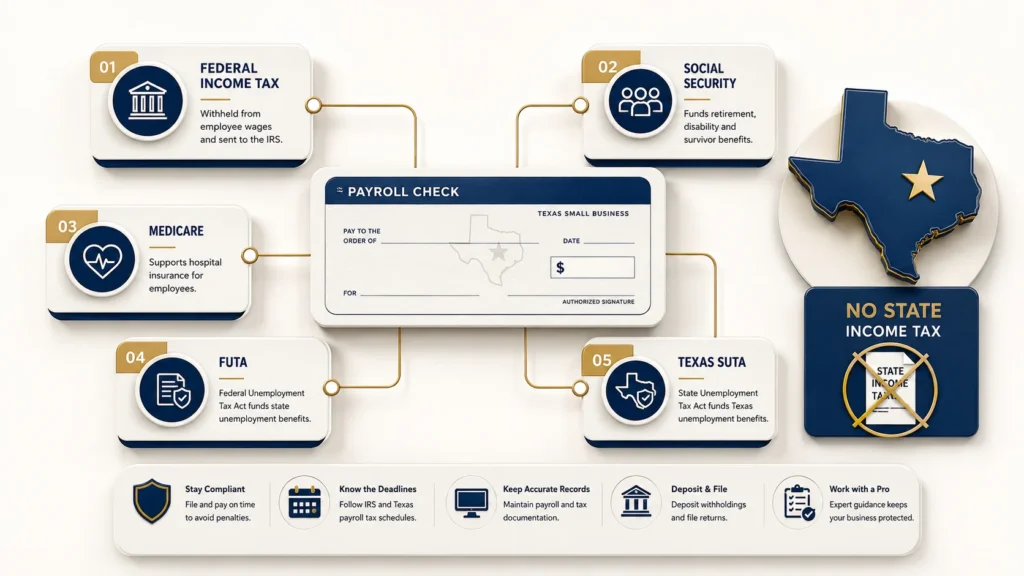
Payroll taxes fund Social Security, Medicare, and unemployment insurance. Some are split between you and your employees, and some you pay alone. Here is the shape of it for a Texas employer:
- You withhold federal income tax and the employee share of Social Security and Medicare from each paycheck.
- You pay the employer share of Social Security and Medicare, federal unemployment tax (FUTA), and Texas state unemployment tax (SUTA).
- You do not withhold any Texas state income tax, because Texas does not have one.
- You report and deposit these taxes on set schedules, and file quarterly and year-end returns.
Federal vs. state obligations
Most of your payroll tax burden is federal. The table below shows the 2026 rates and wage bases. “Wage base” means the cap on wages that a tax applies to for the year.You can check the full federal requirements in the IRS Employer’s Tax Guide.
| Tax | Rate (2026) | Wage base / notes |
|---|---|---|
| Social Security | 6.2% employer + 6.2% employee | First $184,500 of wages |
| Medicare | 1.45% employer + 1.45% employee | No wage cap; extra 0.9% withheld from employee wages over $200,000 (employee only; no employer match) |
| Federal income tax | Per each employee’s Form W-4 | Withheld using IRS tables; no employer match |
| FUTA (employer only) | 6.0%, usually 0.6% after credit | First $7,000 per employee |
| Texas SUTA (employer only) | New employers 2.70% (2026); experienced employers get a TWC-assigned rate | First $9,000 per employee |
| Texas state income tax | None | Texas has no state income tax |
These are 2026 figures; confirm current rates before relying on them. If you hire employees who work in other states, you may also create payroll obligations in that state. Our guide to multi-state payroll for Texas businesses covers that in detail .
A quick example. On a $1,000 paycheck, you withhold $62 for Social Security (6.2%) and $14.50 for Medicare (1.45%). Federal income tax depends on the employee’s Form W-4.
As the employer, you contribute a matching $76.50 in FICA. A new Texas employer may also owe about $27 in SUTA (2.70% on the first $9,000) and, assuming you qualify for the maximum FUTA credit, about $6 in FUTA (0.6% on the first $7,000). No Texas state income tax comes out. This is a simplified example that assumes the employee is still below the FUTA and SUTA wage limits.
No state income tax: what that means
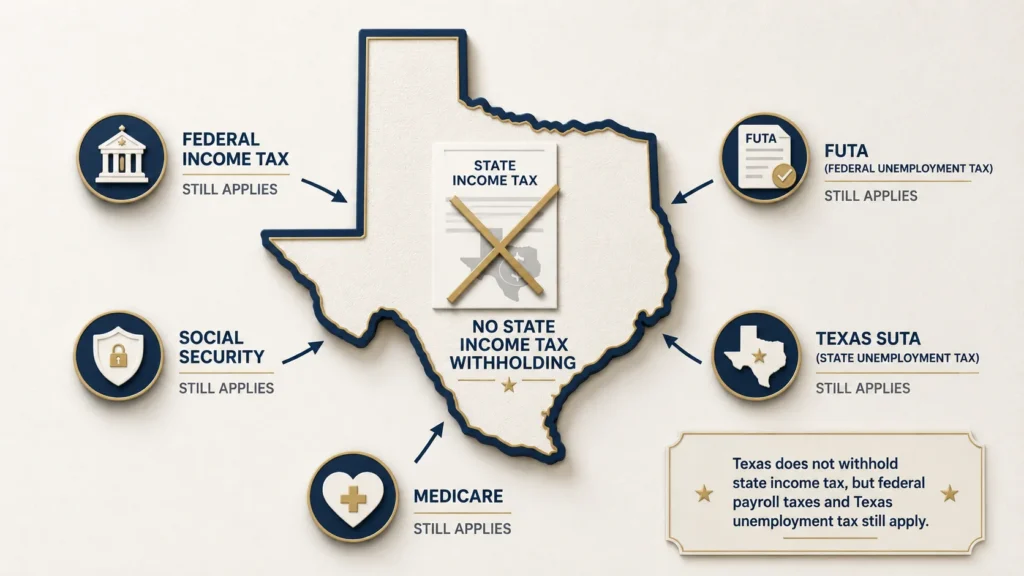
Texas is one of a few states with no personal income tax. For payroll, that has a few practical effects:
- No state income tax withholding. You do not withhold or file a Texas income tax on wages, which is one fewer step than employers face in most states.
- Federal tax still applies. Your employees still owe federal income tax, and you still withhold it.
- State unemployment tax still applies. You still pay Texas SUTA to the Texas Workforce Commission.
- Other business taxes may still apply. Texas has no income tax, but your business may still owe franchise tax, sales tax, or others.
SUTA and the Texas Workforce Commission
Texas state unemployment tax (SUTA) is your main Texas payroll tax. The Texas Workforce Commission (TWC) runs it. A few essentials:
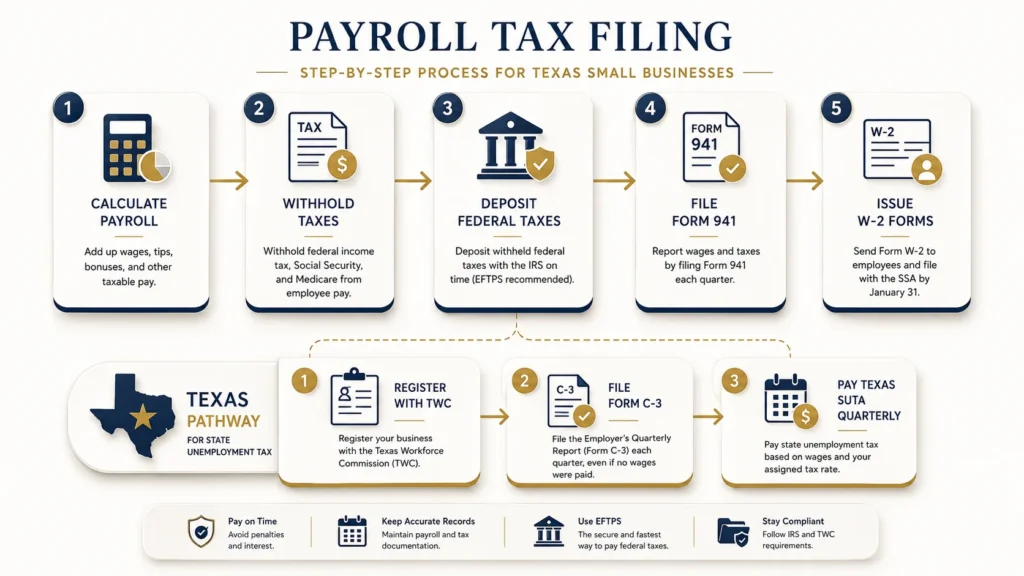
- Register with TWC within 10 days of paying wages and becoming liable for the tax.
- SUTA is employer-only, charged on the first $9,000 of each employee’s wages per year. You do not withhold it from employees.
- Your rate starts at the new-employer rate of 2.7% and is later based on your experience with unemployment claims.
- Report and pay quarterly using TWC’s wage report (Form C-3) through the Unemployment Tax Services system.
- Report new hires to the Texas Office of the Attorney General within 20 calendar days of the hire date.
Deposit schedules and forms
You do not send federal payroll taxes to the IRS at random. You deposit them on a schedule and report them on set forms.
Your deposit schedule is either monthly or semi-weekly. The IRS sets it before the year, based on the tax you reported during a lookback period (for 2026, July 1, 2024 through June 30, 2025). If you reported $50,000 or less in that period, you are a monthly depositor. If you reported more than $50,000, you are semi-weekly. Separately, if you accumulate $100,000 or more in payroll taxes during a deposit period, that amount is due the next business day. Deposits are made through the Electronic Federal Tax Payment System (EFTPS).
The core forms fall into three groups:
Hiring records you keep: Form W-4 records each employee’s federal withholding choices, and Form I-9 verifies their eligibility to work. You keep both on file.
Employment-tax returns you file: Form 941 reports wages and taxes each quarter, and Form 940 reports FUTA once a year.
Year-end and information returns: Forms W-2 and W-3 report each employee’s annual wages to the Social Security Administration, and Form 1099-NEC reports payments to contractors (nonemployees).
Missing a deposit or filing is where penalties start. Our guide to payroll mistakes that trigger IRS penalties breaks down the amounts and how to avoid them (linked below).
2026 payroll tax deadlines calendar
Here are the key federal and Texas filing deadlines. If a due date falls on a weekend or holiday, it moves to the next business day. If you made all deposits on time, you get 10 extra days to file Form 941 or 940.Check the official IRS employment tax due dates before making a deposit or filing a return.
| Filing | What it covers | 2026 due date(s) |
|---|---|---|
| Form 941 (quarterly) | Wages, withholding, FICA | Q4 ’25: Feb 2 · Q1: Apr 30 · Q2: Jul 31 · Q3: Nov 2 · Q4 ’26: Feb 1, 2027 |
| Form 940 (annual) | Federal unemployment (FUTA) | Feb 2, 2026 (for 2025); Feb 1, 2027 (for 2026) |
| W-2 / W-3 and 1099-NEC | Year-end wages; contractor pay | Feb 2, 2026 (for 2025); Feb 1, 2027 (for 2026) |
| Texas unemployment (Form C-3) | State SUTA wages | Apr 30 · Jul 31 · Nov 2 · Feb 1, 2027 |
| Federal tax deposits | 941 taxes | Monthly: by the 15th of the next month · Semi-weekly: by Wed or Fri, based on payday |
Getting help
You can run payroll yourself with software, or hand it to a service. The right choice depends on your time, your team size, and how complex your payroll is. These guides go deeper on each decision:
- Choosing a provider: our ADP vs Gusto vs local payroll comparison weighs the main options for an Allen business.
- Budgeting: see how much payroll costs for a Texas small business for real 2026 price ranges.
- Hiring across state lines: our multi-state payroll guide maps the extra obligations.
- Avoiding penalties: the IRS payroll penalties guide shows what each mistake costs.
- Restaurants: our Allen restaurant payroll guide covers tips, the tip credit, and overtime.
- Switching providers: our mid-year switch guide keeps your W-2s and filings clean.
Tax by Lonestar is a local Allen firm that handles payroll alongside your bookkeeping and taxes. Within the agreed scope, we manage the setup, deposits, and filings, and we flag anything that needs another professional. You provide accurate information and remain responsible for it.
Frequently asked questions
Does Texas have a state payroll tax?
Texas has no state income tax, so there is no state income tax withholding. Texas employers do pay state unemployment tax (SUTA) to the Texas Workforce Commission on the first $9,000 of each employee’s wages, plus the usual federal payroll taxes.
What payroll taxes do Texas small businesses pay?
You withhold federal income tax and the employee share of Social Security and Medicare, and you pay the employer share of Social Security and Medicare, federal unemployment tax (FUTA), and Texas state unemployment tax (SUTA).
When are payroll taxes due in Texas in 2026?
Form 941 is due at the end of the month after each quarter, so April 30, July 31, November 2 (October 31 is a Saturday), and February 1, 2027 for the fourth quarter. W-2s, Form 940, and 1099-NEC for 2025 are due February 2, 2026. Deposits follow your monthly or semi-weekly schedule.
How do I know if I am a monthly or semi-weekly depositor?
It is based on the tax you reported during the lookback period (for 2026, July 1, 2024 through June 30, 2025). If you reported $50,000 or less, you are a monthly depositor. If you reported more than $50,000, you are semi-weekly. Separately, accumulating $100,000 or more in payroll taxes during a deposit period triggers a next-day deposit.
Do I have to register with the Texas Workforce Commission?
Generally yes, once you have employees in Texas. You must register with the TWC within 10 days after becoming liable for Texas unemployment tax. Liability depends on factors like wages paid and worker type, so check TWC’s liability rules, then report and pay the tax each quarter.
The bottom line
Texas payroll comes down to a manageable routine: deposit federal taxes on schedule, pay FUTA and Texas unemployment tax, and file on time each quarter and at year-end. No state income tax makes it simpler than most states, but the federal rules still apply in full. Build the deadlines into your calendar, and the rest follows.
Want a local team to handle it? Tax by Lonestar is based at 825 Watters Creek Blvd, Building M, Suite 250,Office 208, Allen, TX 75013, and serves Allen, Fairview, McKinney, Plano, and Frisco. Call +1 469-888-8492 or book a free payroll consultation.