
Restaurant payroll in Texas is more complex than payroll in many industries. You are managing tipped wages, tip credits, overtime, and frequent hiring. Add federal reporting rules and new 2026 requirements, and a costly mistake becomes easy to make. This guide explains what Allen, TX restaurant owners need to know about tips, wages, overtime, and compliance.
Allen restaurant owners who need help with wages, tax filings, and reporting can use our payroll services in Allen, TX.
Please note: this is general information for restaurant owners, not legal or tax advice. Wage-and-hour and tax rules change and can depend on your facts. Confirm the details with the U.S. Department of Labor, the IRS, the Texas Workforce Commission, or a qualified professional before you act.
Short answer: In Texas, restaurants can pay tipped staff a cash wage as low as $2.13 per hour and take a tip credit of up to $5.12, as long as tips bring each worker to at least $7.25 per hour every workweek. Overtime for tipped staff is based on the full $7.25, not the $2.13 cash wage. Managers can never keep pooled tips. And while a new federal deduction lets some employees deduct tip income at tax time, tips are still subject to payroll taxes and reporting.
What makes restaurant payroll different
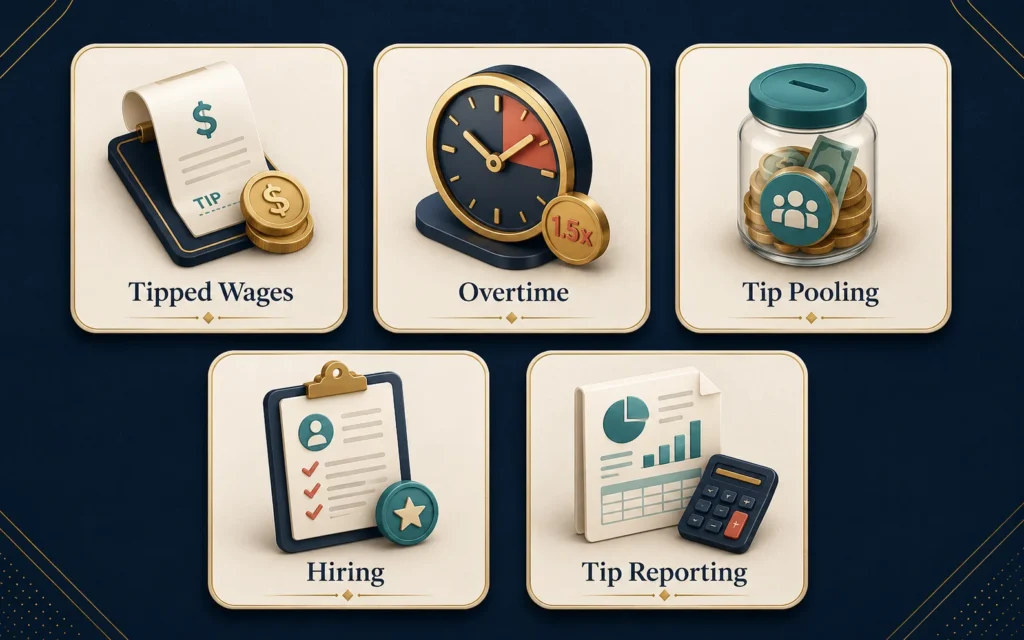
A few things make restaurant payroll more involved than a typical small business:
- Tipped wages and the tip credit, which have their own rules and a notice requirement.
- Overtime math that is based on the full minimum wage, not the lower cash wage.
- Tip pooling rules that limit who can share tips.
- Frequent hiring, which can create repeated onboarding, new-hire reporting, and final-pay work.
- Tip reporting, plus new 2026 rules tied to the federal tip deduction.
Tips and the tip credit in Texas
Texas follows the federal minimum wage and the federal tip-credit rules for tipped employees. A tip credit lets you count a worker’s tips toward your minimum wage obligation, so you can pay a lower cash wage. Here are the 2026 numbers:
| Item | 2026 rate (Texas follows federal) |
|---|---|
| Minimum wage (federal and Texas) | $7.25 / hour |
| Tipped cash wage (the minimum you pay in cash) | $2.13 / hour |
| Maximum tip credit | $5.12 / hour |
| Overtime at minimum wage (non-tipped) | $10.88 / hour (1.5 × $7.25) |
| Minimum cash overtime wage (basic tip-credit example) | about $5.76 / hour (regular rate $7.25, full $5.12 credit) |
| Tipped-employee threshold (federal) | more than $30 / month in tips |

How it works: you pay at least $2.13 per hour in cash, and the worker’s tips must bring the total to at least $7.25 for every hour in the workweek. If tips fall short in any workweek, you must make up the difference. These are 2026 federal figures that Texas follows; confirm current rates before relying on them.
The tip-credit notice: before taking a tip credit, tell the employee the cash wage you pay, the exact credit you claim, and that the credit cannot exceed the tips they actually receive. Explain that the employee keeps all tips except those shared through a valid tip pool. Also explain that the tip credit does not apply until this information has been provided. The notice can be spoken, but keep a written record. If you skip it, you owe the full $7.25 cash wage, even if the employee earned plenty of tips.
Tip pooling: a tip pool is an arrangement where tipped staff share tips. Two rules matter most. First, managers and supervisors can never keep tips from a pool, even if they help serve. A manager may keep a tip given directly for a service the manager alone provided, but cannot take tips from a pool or tip jar that holds other employees’ tips. Second, if you take a tip credit, the pool can only include traditionally tipped staff, such as servers, bartenders, and bussers. You can include back-of-house staff, like cooks and dishwashers, only if you pay the full $7.25 minimum wage and take no tip credit.
Service charges are not tips: a mandatory charge you add to a bill, like an automatic gratuity for large parties, is a service charge. When a mandatory service charge is distributed to an employee, it is generally treated as non-tip wages rather than tip income. It does not count toward the tip credit, and it does not qualify for the tip deduction described below.
The fixed 80/20/30 limits no longer apply: for years, a tipped employee could only spend a limited amount of time on side work, like rolling silverware or brewing coffee, while still being paid the tip-credit wage. In 2024, a federal appeals court that covers Texas vacated that 2021 rule (in Restaurant Law Center v. U.S. Department of Labor), and the Department of Labor restored its earlier “dual jobs” regulation. Related duties can be part of a tipped occupation, so there is no longer a strict time cap. But work performed in a genuinely separate non-tipped occupation must be paid the full minimum wage, without a tip credit. Because this area can shift, confirm the current guidance.
First, a reporting basic: tips of $20 or more that an employee receives in a calendar month must generally be reported to you, and those tips are subject to income tax withholding and Social Security and Medicare (FICA) taxes.
“No tax on tips” does not change payroll: a 2025 federal law lets many tipped workers deduct up to $25,000 of qualified tips on their personal federal income tax return, for tax years 2025 through 2028. That is a deduction the employee claims when filing, and it phases out at higher incomes. It does not change how you run payroll. Tips are still subject to FICA and still must be withheld and reported. Only voluntary tips qualify, not service charges. Because Texas has no state income tax, this affects federal income tax only.
New for 2026 W-2s: employers must report the total cash tips employees report to them in Box 12 using code TP. You also report the employee’s Treasury Tipped Occupation Code in Box 14b. You are reporting the total tips and the occupation code, not deciding the deductible portion yourself; the employee calculates the deduction when they file.
Overtime and split shifts
Overtime is 1.5 times an employee’s regular rate for hours worked over 40 in a workweek. For tipped employees, the regular rate is the full minimum wage, not the $2.13 cash wage. This is where many restaurants make a costly error.
Basic example (calculation): take a tipped employee whose regular rate is the $7.25 minimum and who is paid at the tip-credit wage. Overtime is based on $7.25, so $7.25 × 1.5 = $10.88 per hour. You can still apply the $5.12 tip credit, which leaves a cash overtime wage of about $5.76 per hour. Calculating overtime from the $2.13 cash wage (which would give about $3.20) is wrong and can lead to back pay and penalties.
The exact figure changes if the regular rate is higher. A higher hourly wage or a non-discretionary bonus raises the regular rate, and overtime is based on that higher rate. A worker may also hold two jobs at different pay rates. For example, the worker may serve tables and also work as a host. In that case you usually use a weighted average to find the regular rate.
Split shifts: federal law does not require extra pay for a split shift, and Texas does not either. But every hour worked across all shifts counts toward the 40-hour overtime threshold, so accurate time tracking across shifts and roles matters.
Incorrect overtime calculations can also lead to back wages, tax corrections, and other payroll mistakes that trigger IRS penalties.
Turnover and onboarding
Restaurants tend to have high turnover, so onboarding is nearly constant. Each new hire adds several payroll steps:
- Collect a Form W-4 and complete Form I-9 for each new employee.
- Report the new hire to the Texas Office of the Attorney General within 20 calendar days.
- Give the tip-credit notice and add the employee to your tip pool and time system.
- Set up withholding and tip tracking so pay and reports are correct from the first shift.
Final pay follows the Texas Payday Law: if you discharge an employee, their final pay is due within six calendar days. If they quit, it is due by the next regular payday. The Texas Payday Law also requires you to pay non-exempt employees at least twice a month. With turnover, it is easy to miss a final-pay deadline, so build it into your offboarding routine.
Restaurant payroll compliance checklist
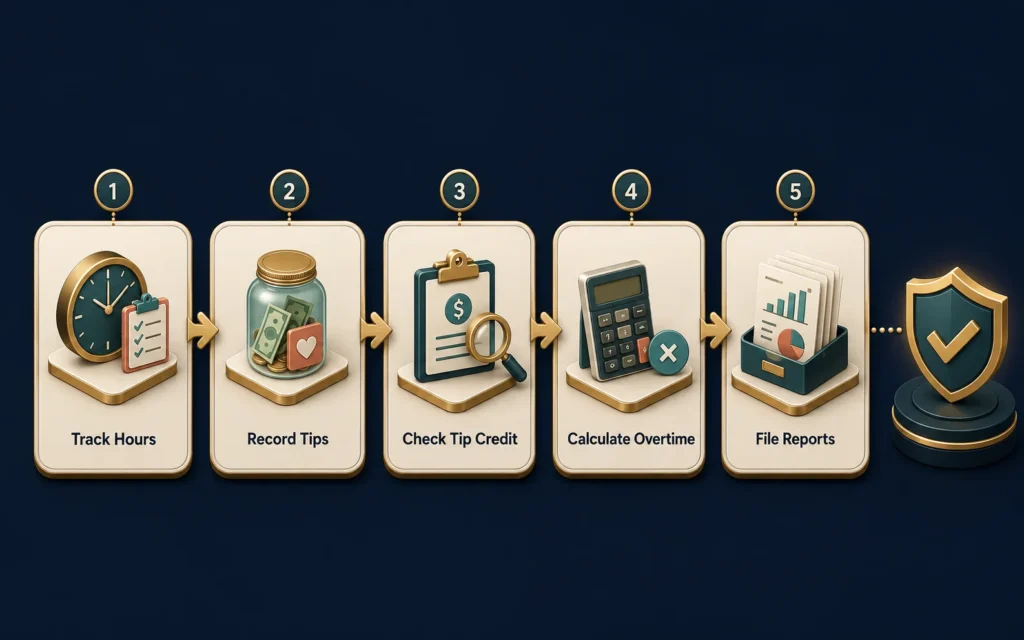
A quick self-check for Allen restaurant owners:
Pay at least $2.13 in cash and confirm tips reach $7.25 each workweek; make up any shortfall.
Give every tipped employee the tip-credit notice before taking the credit.
Base overtime on the full $7.25 (or a higher regular rate), not on $2.13.
Keep managers and supervisors out of tip pools.
Include back-of-house in a tip pool only if you pay the full minimum wage.
Treat mandatory service charges as wages, not tips.
Prepare for the new 2026 Form W-2 tip-reporting fields (Box 12 code TP) and occupation codes (Box 14b).
Report new hires to the Texas Office of the Attorney General within 20 days.
Follow the Texas Payday Law for final pay and pay frequency.
Keep records of hours, tips, and the notices you gave.
Local payroll support for Allen restaurants
Restaurant payroll rewards getting the setup right and keeping it consistent. That is where we help.We are based in Allen and support businesses across our Allen and North Texas service area.
- We help set up payroll processes for tip credits, tip pools, and overtime calculations, so they are right from the start.
- We keep tip reporting and filings on track, including the new 2026 Form W-2 tip fields (Box 12 code TP and the Box 14b occupation code).
- We connect payroll with your restaurant bookkeeping so labor costs, tip records, POS reports, and payroll entries stay organized.
- We keep the scope clear: within the agreed payroll scope, we handle setup and filings, and we flag wage-and-hour or classification questions for review by the appropriate professional. You tell us your pay rates and hours and provide complete, accurate information.
Restaurant payroll costs depend on employee count, pay frequency, tips, overtime, and the filing work included. You can review what payroll service costs for a Texas small business before choosing a provider.
What a first consultation looks like: we review how you pay tipped staff now, whether your tip-credit notice and tip pool meet the rules, how you calculate overtime, and how you track and report tips. We then lay out what to set up or adjust, and which items (if any) need a wage-and-hour attorney or another specialist. It is a working session, not a sales pitch.
Book a free payroll consultation and we’ll walk through your tip-credit setup, overtime, and reporting, and where you can simplify.
Frequently asked questions
What is the minimum wage for tipped restaurant workers in Texas?
In 2026, you can pay a cash wage as low as $2.13 per hour and take a tip credit of up to $5.12, as long as the worker’s tips bring the total to at least $7.25 per hour for the workweek. If tips fall short, you must make up the difference.
How is overtime calculated for tipped employees?
Overtime is based on the full $7.25 minimum wage, not the $2.13 cash wage. That is $7.25 × 1.5 = $10.88 per hour, and you can still apply the $5.12 tip credit, which leaves about $5.76 per hour in cash for overtime. Calculating overtime from $2.13 is a common and costly mistake.
Can restaurant managers or owners share in the tip pool?
No. Managers and supervisors can never keep tips from a tip pool, even if they help serve customers. If you take a tip credit, the pool can only include traditionally tipped staff, such as servers, bartenders, and bussers.
Does “no tax on tips” mean I stop withholding on tips?
No. The deduction is claimed by the employee on their personal tax return. Tips are still subject to Social Security and Medicare taxes and must be withheld and reported through payroll.For 2026, employers must report total cash tips in Box 12 using code TP and the employee’s Treasury Tipped Occupation Code in Box 14b.
Is the 80/20 tip rule still in effect?
A federal appeals court that covers Texas struck down the 80/20/30 rule in 2024, and the Department of Labor removed it. Tipped staff can now do related side work without that strict time cap, as long as it is part of their tipped job. Because this area is shaped by ongoing cases, confirm the current guidance.
The bottom line for Allen restaurants
Restaurant payroll comes down to a few things done consistently: pay the tip-credit wage correctly and make up any shortfall, give the tip-credit notice, base overtime on the full minimum wage, keep managers out of tip pools, and stay on top of reporting and turnover deadlines. Get the setup right, and the rest becomes routine.
Want help getting it set up? Tax by Lonestar is based at 825 Watters Creek Blvd, Building M, Suite 250, Allen, TX 75013, and serves Allen, Fairview, McKinney, Plano, and Frisco. Call +1 469-888-8492 or book a free payroll consultation for your restaurant.