Payroll tax mistakes can lead to fast and costly penalties. Part of the reason is that much of the money is “trust fund” money. That means taxes you withhold from employees’ paychecks and hold for them until you pay it to the IRS. Miss a payroll deposit deadline, and a penalty can start after one day. File a return late or with errors, and other penalties may apply. The good news is that many common payroll penalties come from a short list of avoidable mistakes. This guide covers the specific errors that trigger IRS penalties in 2026, what each one costs, and how to prevent it.
Businesses that need help managing deposits, filings, and payroll records can use our payroll services in Allen, TX.
Please note: this is general information for small-business owners, not legal or tax advice. Penalty rules and amounts can change, and your situation may differ. Confirm current figures with the IRS or a qualified tax professional before you act.
Short answer: Many IRS payroll penalties come from a few avoidable errors: paying payroll tax deposits late, filing Form 941 late or incorrectly, not paying over the taxes you withheld, misclassifying workers, and sending W-2s or 1099s late or wrong. Penalties range from 2% of a late deposit up to 100% of unpaid trust-fund taxes. That 100% penalty can be assessed personally against owners, officers, or other people who were responsible and acted willfully. Preventing these is mostly about deadlines, accuracy, and letting nothing slip.
Top penalty triggers
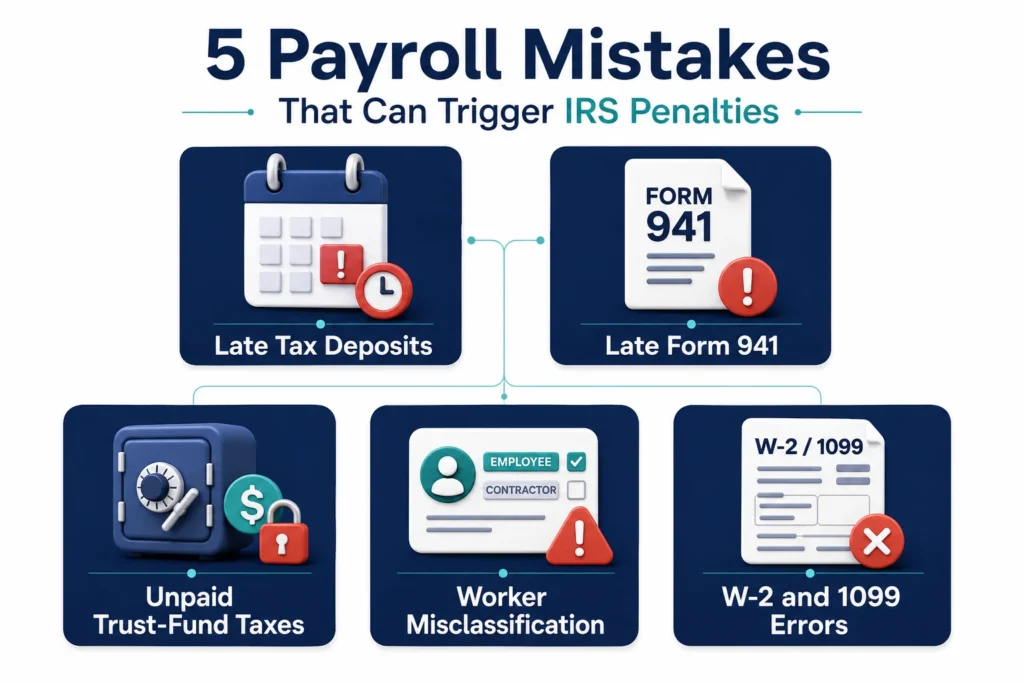
Most payroll penalties trace back to five errors:
- Late tax deposits. One of the most common. Penalties start after a single day.
- Late or incorrect Form 941 quarterly returns.
- Withholding taxes but not paying them over to the IRS. This can become a personal liability.
- Misclassifying employees as contractors, which skips required withholding.
- Late, missing, or incorrect W-2s and 1099s.
The sections below cover the big ones. A table near the end lists the amounts.
Late or misfiled Form 941s
Form 941 is the federal payroll tax return you file each quarter. It reports wages, withheld income tax, and Social Security and Medicare taxes. It is normally due by the last day of the month after each quarter ends. For example, the first-quarter return is due April 30. If you made all required deposits on time and in full during the quarter, you generally get ten extra calendar days to file.
Two penalties can apply if you miss the deadline:
- Failure to file: 5% of the unpaid tax for each month or part of a month the return is late, up to 25%. If the return is more than 60 days late, a minimum penalty applies. For returns required in 2026, that minimum is the lesser of $525 or 100% of the tax owed.
- Failure to pay: 0.5% of the unpaid tax per month, up to 25%, if you report the tax but do not pay it.
If you file late and also pay late, the two penalties overlap. In a month where both apply, the filing penalty is reduced to 4.5%. The combined rate is then 5% per month, up to 25%. Filing on time still matters. On its own, the filing penalty is much larger than the payment penalty (5% versus 0.5% per month). So even if you cannot pay in full, file the return on time and pay what you can.
Common 941 errors include skipping a quarter, wage-total or math mistakes, using the wrong employer identification number, and 941 totals that do not match your year-end W-2s.
Deposit timing errors
This is one of the most common payroll penalties, and it surprises owners because it starts after a single day. The IRS requires you to deposit withheld payroll taxes on a set schedule. That schedule is either monthly or semi-weekly, based on your past payroll size (your “lookback period”). If you build up $100,000 or more in payroll tax liability, the deposit is due the next business day.
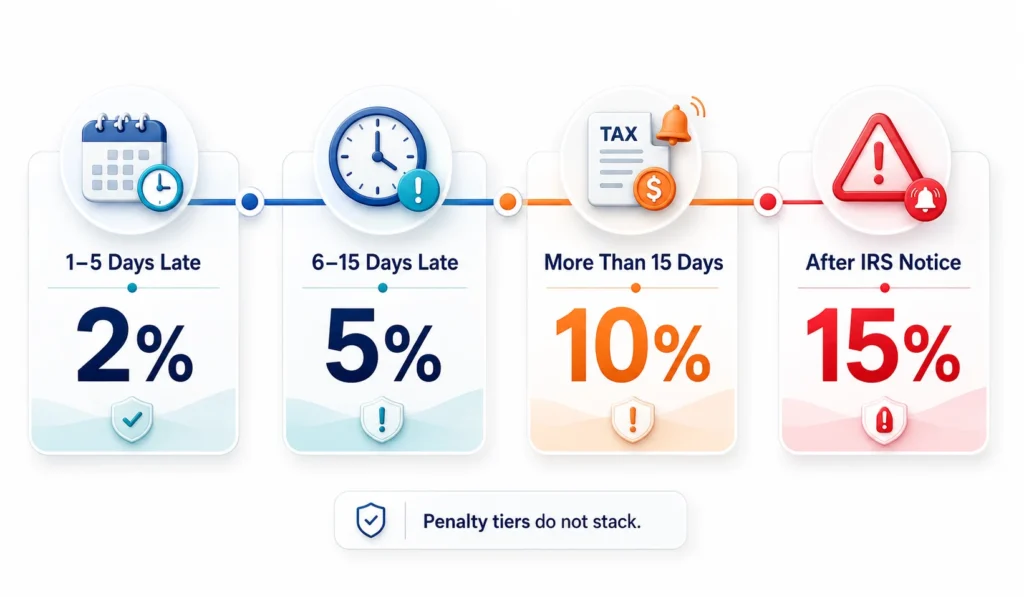
The failure-to-deposit penalty rises the later you are. It starts at 2% for a deposit that is 1 to 5 days late and climbs to 15% once the amount stays unpaid after an IRS notice. The full tiers are in the table below. One detail surprises people: the tiers do not stack. If a deposit is more than 15 days late, the penalty is 10% of the deposit, not 2% plus 5% plus 10%. To prevent this, learn your deposit schedule, deposit through the Electronic Federal Tax Payment System (EFTPS), and set reminders or automate deposits so a due date never slips.
Worker misclassification
Treating an employee as an independent contractor is one of the costliest payroll mistakes. It skips the withholding and employer taxes you were supposed to pay. If the IRS reclassifies a worker as an employee, you can owe the income tax you should have withheld, both halves of Social Security and Medicare, and federal unemployment tax, plus penalties and interest. Reduced-rate relief may apply if the misclassification was unintentional.
Intentional misclassification can lead to greater employment-tax liability and additional penalties. The Trust Fund Recovery Penalty, described below, is separate. It applies when trust-fund taxes are willfully not collected or paid over, so it is not an automatic result of misclassification.
Because this topic is detailed, read our 1099 vs W-2 worker classification guide before deciding how to classify someone. The short version: when a worker’s status is unclear, review the IRS control factors and get advice before you default to “contractor.”
Penalty amounts at a glance
Here are the main federal payroll penalties and what they cost in 2026. Interest may also accrue on unpaid taxes and penalties, and it compounds daily.
| Penalty | What triggers it | Amount (2026, federal) |
|---|---|---|
| Failure to deposit (IRC §6656) | Payroll tax deposits made late | 2% (1–5 days late), 5% (6–15 days), 10% (more than 15 days), 15% (unpaid after an IRS notice). Tiers do not stack. |
| Failure to file (IRC §6651) | Form 941 or 940 filed late | 5% of the unpaid tax per month or part-month, up to 25%. If more than 60 days late, a minimum penalty applies (the lesser of $525 or 100% of the tax). |
| Failure to pay (IRC §6651) | Tax reported but not paid | 0.5% of the unpaid tax per month, up to 25%. If both this and failure-to-file apply in a month, the filing penalty drops to 4.5% (5% combined). |
| Trust Fund Recovery Penalty (IRC §6672) | A responsible person willfully fails to pay over withheld trust-fund taxes | 100% of the unpaid trust-fund taxes, and it can be charged personally to responsible people |
| W-2 / 1099 errors (IRC §6721 & §6722) | Late, missing, or incorrect information returns | $60, $130, or $340 per return by how late it is. Intentional disregard is $680 per return with no annual maximum. Can apply to the IRS copy and the payee copy separately. |
| Interest | Any unpaid tax or penalty | May accrue and compounds daily. The federal underpayment rate is 7% for Q3 2026, but the IRS changes it quarterly. |
These are federal penalties and can change. Amounts are indexed or adjusted periodically, so confirm current figures on the IRS pages in Sources before relying on them. For payments made after December 31, 2025, the threshold for issuing certain 1099 forms rose from $600 to $2,000 under 2025 federal legislation; confirm the current threshold before filing. When you publish this table, render it as a responsive HTML table, not an image, so it reads well on mobile.
The penalty that gets personal: the Trust Fund Recovery Penalty
Most business penalties stay with the business. The Trust Fund Recovery Penalty is different. It applies when a business withholds income tax and the employee share of Social Security and Medicare, but a responsible person willfully fails to pay it over. The IRS can then assess a penalty equal to 100% of those unpaid trust-fund taxes. It can be charged against the responsible people involved. That can include owners, officers, and certain managers. It applies to them personally, even if the business is a corporation or LLC. This is why you should treat withheld payroll taxes as a top payment priority. If cash is tight, the trust-fund portion is the last thing to skip.
How to avoid payroll penalties
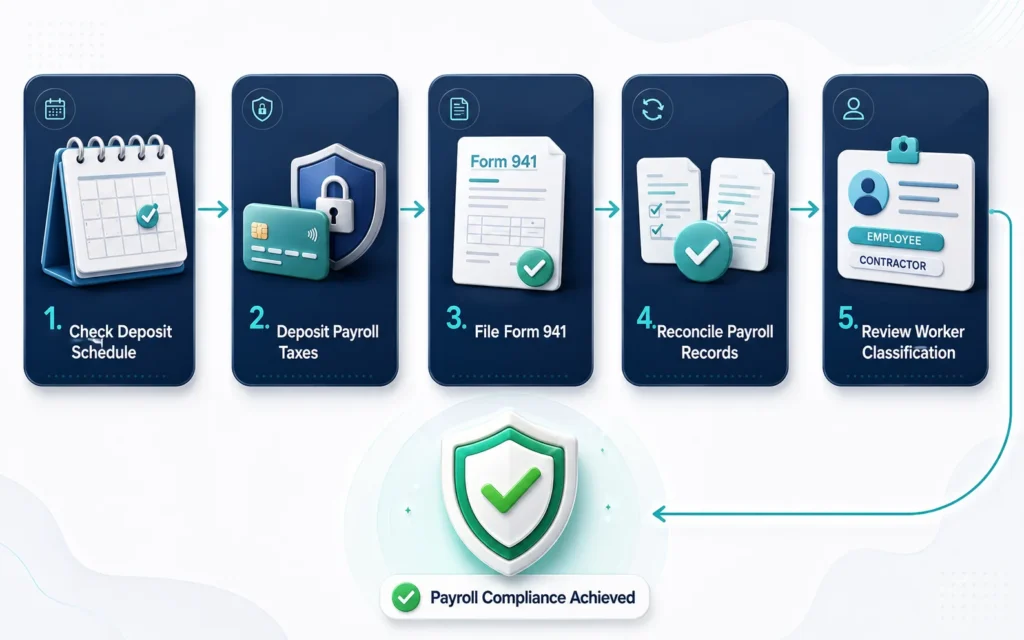
You cannot promise you will never make a mistake. But you can greatly reduce the risk of a penalty with a few habits:
- Learn your deposit schedule (monthly or semi-weekly) and the next-day rule for large liabilities.
- Deposit through EFTPS and automate or set reminders so a due date never slips.
- File Form 941 on time every quarter, even if you cannot pay in full, and pay what you can.
- Pay over withheld taxes as a top priority, before other expenses, to avoid trust-fund exposure.
- Reconcile your four quarterly 941s with your year-end W-2s and Form W-3 so the totals match.
- Classify workers correctly and review any borderline contractor before their first payment.
- Send W-2s and 1099s on time and correctly to avoid information-return penalties.
- If something slips, act fast. File and pay as soon as you can, and ask about penalty relief. The IRS offers first-time penalty abatement and reasonable-cause relief for some penalties. First-time abatement generally applies to late filing, payment, and deposit penalties, but not to W-2 and 1099 information-return penalties.
Before outsourcing payroll, you can also review what payroll service costs for a Texas small business.
A payroll note for Allen and Texas businesses
Every penalty in this guide is federal, so it applies the same to a business in Allen as anywhere else. Texas does add one point in your favor: with no individual state income tax, there is no Texas state income-tax withholding to get wrong, which is one less filing than employers face in most states. You still have Texas Workforce Commission unemployment tax, which has its own deadlines and penalties. Our Texas Workforce Commission reporting guide explains the filing process.
One thing worth checking as you grow is your federal deposit schedule. The IRS sets it before each calendar year, based on the tax you reported during a lookback period (for 2026, July 1, 2024 through June 30, 2025). Business growth can raise that reported tax and change your schedule in a later year. A monthly depositor can also switch to semi-weekly right away after reaching the $100,000 next-day deposit rule. If your team has grown recently, confirm your current deposit schedule before the next payroll.
[ if Tax by Lonestar has genuinely seen a recurring local payroll issue, add one brief real observation here. If not, leave the factual paragraph above as-is — do not add an invented first-hand claim.]
Frequently asked questions
How much is the IRS penalty for paying payroll taxes late?
The failure-to-deposit penalty is 2% if the deposit is 1 to 5 days late, 5% if 6 to 15 days late, 10% if more than 15 days late, and 15% if it stays unpaid more than 10 days after an IRS notice. The tiers do not stack, and interest is charged on top.
What is the Trust Fund Recovery Penalty?
It is a penalty equal to 100% of the withheld income tax and employee-share Social Security and Medicare taxes that a responsible person willfully fails to pay over to the IRS. The IRS can assess it personally against owners, officers, and other responsible people, even for a corporation or LLC.
Can the IRS come after me personally for my company’s payroll taxes?
For the trust-fund portion, it can. Through the Trust Fund Recovery Penalty, the IRS can hold responsible individuals personally liable for taxes withheld from employees that were not paid over. This is one reason to treat withheld taxes as a top payment priority.
What is the penalty for filing Form 941 late?
Filing late generally costs 5% of the unpaid tax per month, up to 25%. If the return is more than 60 days late, a minimum penalty applies (for 2026, the lesser of $525 or 100% of the tax). If you filed but did not pay, a separate 0.5% monthly penalty applies. Filing on time, even when you cannot pay in full, avoids the larger penalty.
Can an IRS payroll penalty be removed?
Sometimes. The IRS offers first-time penalty abatement for eligible taxpayers and reasonable-cause relief when you can show a valid reason. First-time abatement generally applies to late filing, payment, and deposit penalties, but not to W-2 and 1099 information-return penalties, which usually require reasonable cause.
The bottom line
IRS payroll penalties can become costly quickly. But they often come from a predictable list: late deposits, late or incorrect Forms 941, unpaid trust-fund taxes, worker misclassification, and late or incorrect W-2s and 1099s. Build a simple routine around deposit deadlines, on-time filing, and accurate classification, and you reduce much of the risk. When something does slip, act quickly and ask about relief.
Want a second set of eyes on your payroll? Tax by Lonestar is based at 825 Watters Creek Blvd, Building M, Suite 250, Allen, TX 75013, and serves Allen, Fairview, McKinney, Plano, and Frisco. Call +1 469-888-8492 or book a free payroll consultation, and we’ll help you keep deposits and filings on track.