Self-employed tax preparation is different from filing as an employee, and the differences catch people off guard. No employer withholds your taxes. No one sets money aside for Social Security and Medicare. You handle all of it, usually four times a year.
The upside is that self-employment also opens up deductions an employee cannot take. Handled well, that can offset a meaningful part of the extra tax.
This guide explains what is different, in plain terms. Self-employment tax, quarterly estimated payments, the deductions worth tracking, the records to keep, and retirement options that also lower your tax bill. If you would rather hand it off, see our tax preparation services.
One note before we start. This is general information, and the figures that change each year are flagged so you can confirm them. When a number matters to your return, check the current IRS guidance or ask a professional.

Self-employment tax explained
Self-employment tax is how self-employed people pay into Social Security and Medicare. As an employee, you and your employer split those taxes. On your own, you pay both halves. The rate is set in law at 15.3 percent, made up of 12.4 percent for Social Security and 2.9 percent for Medicare (IRS Topic 554).
A few details soften the sting. You pay self-employment tax on about 92.35 percent of your net self-employment earnings, not the full amount. The Social Security portion applies only up to an annual wage base that changes each year, while the Medicare portion applies to all of your earnings (IRS). You generally owe self-employment tax once your net earnings reach $400 for the year.
There is also a built-in deduction. You can deduct half of your self-employment tax when figuring your adjusted gross income (IRS). It does not reduce the self-employment tax itself, but it lowers your income tax, and it mirrors the half an employer would have paid.
Two points trip people up. First, self-employment tax is separate from income tax. You can owe self-employment tax even in a year when your income tax is low. Second, it is calculated on Schedule SE and added to your return, so it is easy to overlook until it appears.
The practical takeaway is to plan for it. A common habit is to set aside a portion of every payment you receive for taxes, so the bill is already covered when it comes due. The right percentage depends on your total situation, so estimate it or ask a professional rather than guessing.
Quarterly estimated payments
Because no one withholds tax from your income, the IRS asks you to pay as you go, through estimated tax payments. You generally need to make them if you expect to owe at least $1,000 for the year after subtracting any withholding and refundable credits (IRS).
These payments cover both your income tax and your self-employment tax together. You estimate the year’s total, divide it across the payment periods, and send each installment with Form 1040-ES or through an IRS online payment option.
The periods are not evenly spaced, which surprises people. They do not line up as neat three-month blocks, so it is worth reading the dates rather than assuming each is three months after the last.
2026 ESTIMATED PAYMENT DATES
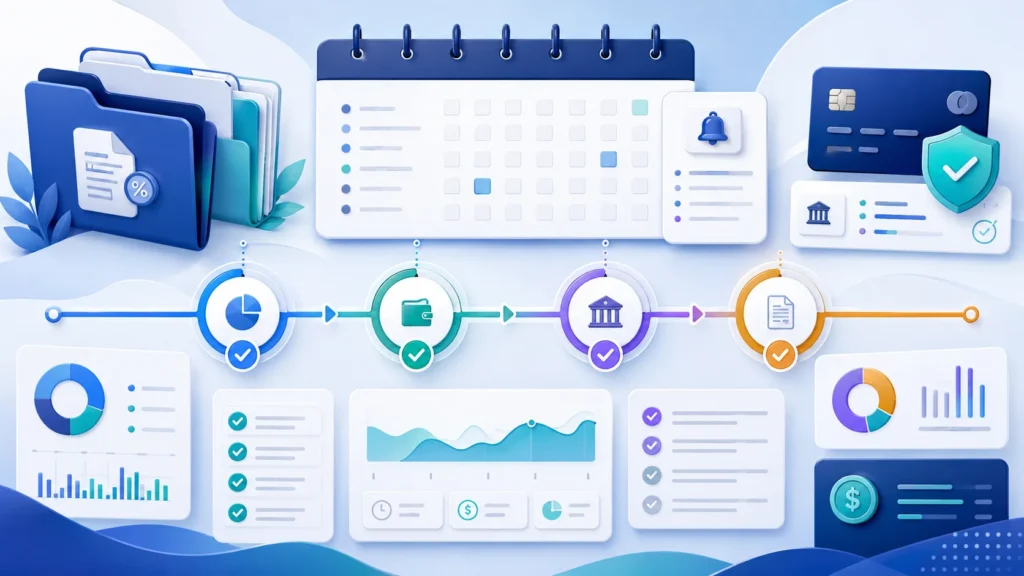
For 2026 income, the estimated payment due dates for most calendar-year filers are:
- First payment: April 15, 2026.
- Second payment: June 15, 2026.
- Third payment: September 15, 2026.
- Fourth payment: January 15, 2027.
If a due date falls on a weekend or holiday, it moves to the next business day. You can also skip the January payment if you file your return and pay the balance in full by early February. Confirm the current dates on the IRS estimated taxes page before you rely on them.
Missing a payment can bring an underpayment penalty, even if you pay in full at filing. There is a common way to stay safe. Paying either a set percentage of this year’s expected tax or a set percentage of last year’s tax, known as a safe harbor, generally avoids the penalty. The exact percentages depend on your income, so confirm them for your situation.
A simple system helps. Move a share of each payment you receive into a separate account, calculate your estimate once a quarter, and pay it. Keeping the tax money apart from your operating cash is what makes the deadlines painless.
Top deductions for the self-employed
Deductions are where self-employment gives something back. The rule is simple in principle. An expense is deductible when it is ordinary and necessary for your business. The detail is in the records, so track these as you go.

Home office
If you use part of your home regularly and exclusively for business, you may be able to deduct a portion of your home costs. Exclusive use is the part people get wrong. A desk in the corner of a room used for other things generally does not qualify, while a room used only for work can. There is a simplified method based on square footage and a regular method based on actual costs, so compare the two.
Vehicle and mileage
If you drive for business, you can deduct the cost, using either the standard mileage rate or your actual vehicle expenses. Either way, you need a record of business versus personal miles, kept as you drive rather than reconstructed later. Commuting from home to a regular workplace generally does not count.
Health insurance
Self-employed people who pay their own health insurance may be able to deduct the premiums, subject to specific rules. This one is often missed, and it can be significant.
Other common deductions
- Supplies, software, and equipment used for the business.
- A portion of your phone and internet, based on business use.
- Business travel and a portion of qualifying meals.
- Professional services, such as legal, accounting, and bookkeeping fees.
- Advertising, marketing, and website costs.
- Business insurance and professional licenses.
- Retirement plan contributions, covered below.
- Half of your self-employment tax, as noted earlier.
There may also be a deduction for qualified business income, often called the QBI deduction, which can let eligible self-employed people deduct a portion of their business income. Eligibility and limits are specific and change over time, so confirm whether it applies to you rather than assuming. Our guide to self-employed deductions goes deeper on the ones that matter most.
A word of caution. A deduction you cannot support is a deduction you may lose if anyone asks. Aggressive guessing is not a strategy. Claim what you genuinely qualify for, and keep the records behind it.
Recordkeeping
Good records are what make everything above work. They support your deductions, make your quarterly estimates accurate, and turn tax time into a short task instead of a reconstruction project.
Separate your money first. Use a dedicated business bank account and card. When business and personal spending mix, every deduction gets harder to prove and your books get harder to trust. This one habit prevents more problems than any other.

Keep the records the IRS expects, which are the ones that clearly show your income and expenses. In practice, that means income records, receipts and proof of payment for expenses, bank and card statements, mileage logs, and copies of the forms you file.
For expenses that are not self-explanatory, note the business purpose. A receipt shows that you spent money, but not always why it was for the business. A short note on meals, travel, and mixed-purpose purchases saves you later.
Do it through the year, not at the end. A few minutes each week to record income and file receipts beats a frantic reconstruction in April. Accounting software or a simple spreadsheet both work, as long as you keep it current.
Retention matters too. Many federal tax records should be kept for at least three years, though some situations call for longer. Confirm the period that applies to your records. Our guide to organizing tax records covers this in more detail.
Retirement options that lower taxes
Retirement plans are one of the few tools that build your savings and cut your tax bill at the same time. Self-employed people have options an employee does not, and the contribution limits are often higher.

Several plans are designed for self-employed people and small businesses, including SEP IRAs, SIMPLE IRAs, and solo 401(k) plans. They differ in how much you can contribute, how much paperwork they require, and whether you have employees. A traditional or Roth IRA is also available alongside them.
The tax benefit depends on the plan. Contributions to some plans are deductible now and taxed later when you withdraw. Roth contributions work the other way, with no deduction now but tax-free qualified withdrawals later. Which fits depends on your income and your expectations for the future.
Contribution limits, deadlines, and rules change, and some plans must be set up by specific dates to count for a given year. Because the numbers and deadlines shift, confirm the current limits before you contribute, and consider setting the plan up well before year end so you have time to fund it.
This is an area where advice pays off. The right plan depends on your income, whether you have employees, and your goals, so it is worth a conversation with a tax professional or financial adviser rather than a guess.
When to get help
You can prepare a self-employed return yourself, and plenty of people do. But this is an area where help often pays for itself, because the rules are more involved and the stakes are higher than a simple W-2 return.
A few signs point toward getting help. Your income grew and the tax bill grew with it. You are not sure whether you are setting aside enough. You started missing or guessing at quarterly payments. You are leaving deductions on the table because you are not sure what qualifies. Or you simply want your time back.
A good preparer does more than fill in forms. They help you plan estimated payments, find deductions you missed, choose a retirement plan, and avoid the errors that are common in the first profitable year. That planning is often worth more than the preparation itself.
Clean records make their work faster. When your books are current, the preparer spends time on strategy rather than sorting your year, which may reduce the time they need, though the final fee still depends on your situation.
Using a professional does not remove your responsibility. Review the return, ask about anything you do not understand, and keep your own records. The goal is a partnership, not a handoff you never look at again.

Book a free tax consultation
Tax by Lonestar prepares returns for self-employed people and small businesses in Allen and across Collin County.
In a free consultation, we look at your income, your estimated payments, and your deductions, and map out what your return will involve. Contact us to set one up.
This guide is general information, not tax, legal, or financial advice. Tax rules, rates, and limits change and depend on your situation. For advice on your return, talk to a qualified tax professional, accountant, or CPA.