
A year-end bookkeeping checklist is what makes tax season calm instead of chaotic. The work you do in December and January decides how smooth the filing goes. Clean books hand off easily. Messy ones turn into a scramble.
This guide walks through the year-end close for a Texas small business. It covers reconciling every account, preparing 1099s, handling fixed assets and depreciation, sorting owner draws, reviewing your financial statements, and handing the file to your tax preparer.
Texas businesses have their own mix of deadlines. There is no personal state income tax, but you still deal with federal filings, sales tax, and the annual franchise or information report. We flag those along the way. You can also see our bookkeeping services if you would rather hand the close off.
One note on timing. Rules, thresholds, and deadlines change from year to year, and some shift when a due date lands on a weekend. Confirm the current figures with the IRS, the Texas Comptroller, or your tax professional before you rely on them.
A year-end timeline
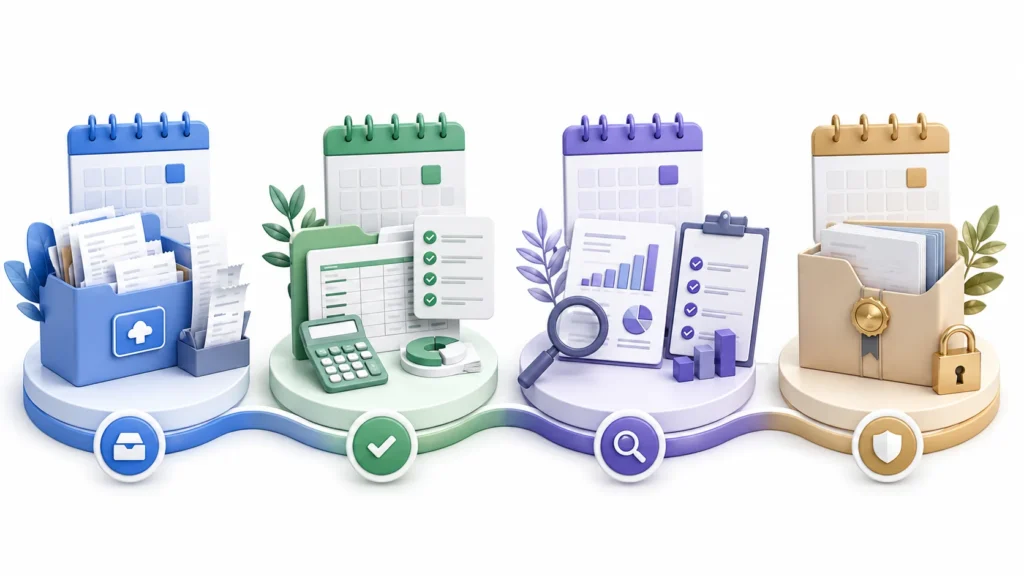
Spreading the work over a few weeks beats doing it all in one panicked sitting. Here is a sample timeline to adapt to your business.
| When | Focus |
|---|---|
| December | Catch up on data entry, chase missing receipts, collect W-9s from contractors, review fixed asset purchases |
| Early January | Reconcile every account through December 31, clear uncategorized transactions, record adjusting entries |
| Mid January | Prepare and file 1099s, review owner draws and distributions, run draft financial statements |
| Late January | Final review, lock the year if your software allows, hand off to your tax preparer |
Adjust the dates to fit your business. A December-heavy retailer may push more work into January. A quiet service business may finish early.
Reconcile all accounts
Everything else depends on this step. If your accounts are not reconciled, your reports may contain missing, duplicated, or incorrectly recorded transactions, and your tax return is built on those numbers.
Reconcile every account through December 31. That means each bank account, each credit card, each loan, and each merchant or payment app. Nothing gets skipped because it looks small.
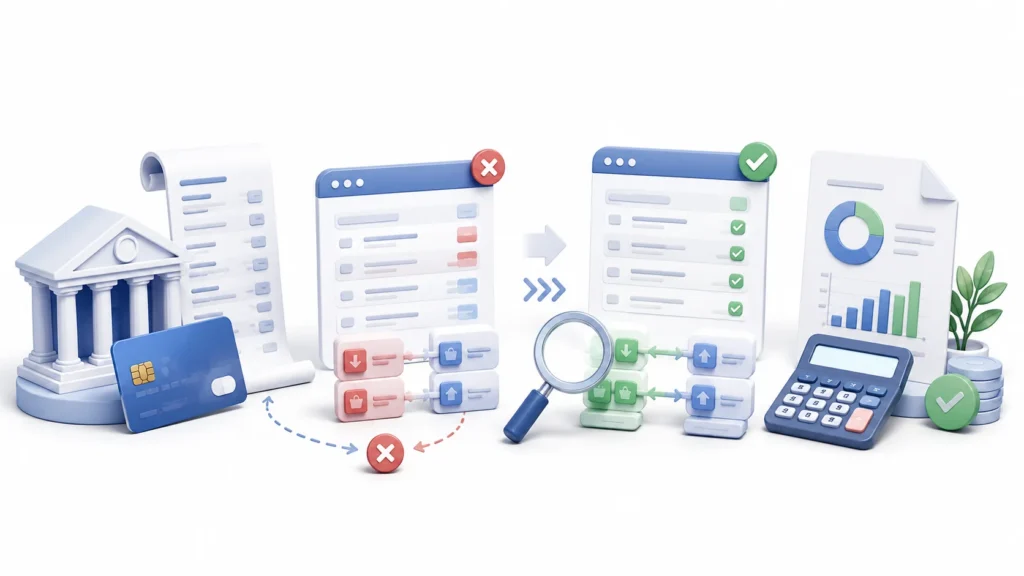
Reconciling is more than matching a balance. Account for outstanding checks, deposits in transit, bank fees, interest, and any missing entries. After those adjustments, the reconciled bank and book balances should agree.
Watch for duplicated income while you reconcile. A common year-end cleanup issue is a bank-feed deposit that was added as new income even though the matching invoice payment was already recorded. That double counts the sale, inflates revenue, and has to be corrected before the reports are final. Matching the deposit to the existing payment, rather than adding it, prevents the problem.
Clear out the leftovers too. Anything sitting in an uncategorized or holding account needs a home before you close. Those leftovers are one of the most common reasons year-end reports look wrong.
Check your balance sheet accounts while you are here. Loan balances should match lender statements. Sales tax payable should tie to what you filed and paid. Payroll liabilities should match what was actually remitted.
If you keep a steady monthly routine, this step is short, because most of it is already done. If you are behind, budget real time for catch-up work. Our monthly bookkeeping checklist covers the routine that keeps year-end from becoming a cleanup project.

1099 prep
If you paid contractors during the year, you may need to file Form 1099-NEC. This is one of the earliest year-end filing deadlines, so it deserves attention in December rather than late January.
There is an important change for 2026. For payments made on or after January 1, 2026, the nonemployee compensation reporting threshold rose from $600 to $2,000. The IRS instructions for the December 2026 revision direct filers to report nonemployee compensation of $2,000 or more. The old $600 threshold still applies to earlier payment years, so do not apply the new figure backwards.
The deadline is tight. Form 1099-NEC is generally due to both the recipient and the IRS by January 31 (IRS). When that date falls on a weekend or legal holiday, it moves to the next business day. For payments made during 2026, that means Form 1099-NEC is due to the recipient and the IRS by February 1, 2027, because January 31, 2027 falls on a Sunday. Confirm the date for the season you are filing in.
Here is the practical sequence:
- Collect a Form W-9 from every contractor before you pay them, not after.
- Run a report of payments by vendor for the calendar year.
- Identify which vendors meet the current reporting threshold.
- Separate payments made by check, cash, ACH, or direct transfer from qualifying card and third-party network payments. Card and qualifying network payments are generally reported by the payment processor on Form 1099-K, not by you on Form 1099-NEC.
- Confirm names, addresses, and taxpayer ID numbers against the W-9s.
- File with the IRS and send recipient copies by the deadline.
Missing or late filings can bring penalties, and the amount depends on how late you are. You generally must file electronically when you are required to submit 10 or more information returns in total. Confirm the rule before filing, because thresholds can change.
The most common trip-up is a missing W-9. Chasing a contractor for a tax ID in late January is unpleasant. Collecting it up front takes a minute.
Payroll year-end tasks
If you have employees, payroll adds its own year-end work, and several deadlines land close together in January. Handle these alongside your 1099 prep.
- Reconcile your payroll reports to the general ledger, so wages and taxes agree with your books.
- Confirm employee names, addresses, and Social Security numbers before forms go out.
- Prepare and review Forms W-2 and W-3.
- Reconcile your quarterly Forms 941, or Form 944 if you file annually.
- Review your Form 940 federal unemployment requirements.
- Check payroll liability accounts before closing, so what is owed matches what was remitted.
Texas adds a state layer. Liable employers report wages and pay state unemployment tax through the Texas Workforce Commission, and quarterly wage reports are generally due by the end of the month following the quarter. That puts the fourth-quarter report in the same crowded stretch of January as your other filings.
If a payroll service handles these filings for you, your job is to reconcile rather than prepare. Check that the totals in your books match the reports the service filed, and ask about anything that does not line up.
Fixed assets and depreciation
Year-end is when you sort out the bigger purchases. A laptop, vehicle, machine, or piece of kitchen equipment may need to be recorded as a fixed asset. The correct treatment depends on its cost, expected life, your accounting policy, and current tax rules.
Start with a review. List what you bought during the year and what it cost. Confirm each item is recorded as an asset rather than buried in an expense account. Add anything you disposed of, sold, or scrapped, since those need to come off the books.
Then handle depreciation. Depreciation spreads the cost of an asset across the years you use it. Some purchases may qualify for accelerated write-offs under provisions like Section 179 or bonus depreciation, which can change how much you deduct now versus later.
This is a place to be careful. Depreciation limits, thresholds, and elections change frequently, and recent federal tax legislation has adjusted several of them. Rather than working from a figure you read somewhere, confirm the current rules with the IRS or your tax professional for the year you are filing.
What your bookkeeping needs to deliver is clean data. An accurate fixed asset list with purchase dates, costs, and descriptions. Your tax preparer decides the depreciation treatment from there. That split of duties keeps you out of trouble.
Keep the supporting documents together. Invoices, loan documents for financed equipment, and any trade-in details all matter later.
Owner draws and distributions
This section catches a lot of small businesses. Money that moves between you and the business needs to be recorded correctly, and year-end is when errors surface.
Review every transfer between personal and business accounts. Each one should be coded as an owner draw, an owner contribution, a distribution, or payroll, depending on your entity type and how the payment was made.
Personal expenses paid from the business account are the usual culprit. A grocery purchase or personal subscription should not remain recorded as a business expense. It should be removed from business expenses and reclassified according to the entity type. It may be an owner draw, a distribution, a payroll item, or an amount due from the owner, so confirm the treatment with your tax professional. Leaving it coded as an expense overstates your costs and can create problems on the return.
Entity type matters here. A sole proprietor or partner typically takes draws. An S corporation owner who works in the business generally needs reasonable compensation through payroll, with distributions handled separately. The right treatment depends on your structure, so this is a good question for your tax professional.
Check the equity section of your balance sheet before you close. Owner contributions, draws, and distributions should each be recorded in the right place, and the totals should make sense against what actually moved.
Going forward, separate accounts make this far easier. When business and personal money stay apart, there is much less to untangle each December.
Inventory, receivables, and payables
These three areas sit on your balance sheet and are easy to leave stale. Year-end is when they need a proper look.
If you sell products, confirm the year-end inventory quantity and value. Investigate damaged, missing, obsolete, or unsellable stock, and make sure your inventory records agree with your accounting system. Inventory methods and requirements vary by business, so check the treatment that applies to yours.
Then review unpaid customer invoices and vendor bills. Confirm the balances are real. Follow up on overdue customer accounts, remove duplicates, and clear anything that was already paid but never marked as such.
Discuss potentially uncollectible balances with your tax preparer rather than writing them off on your own. Bad-debt treatment depends partly on whether you use cash or accrual accounting, so an overdue invoice does not automatically produce a deduction.
Old, unexplained balances in receivables or payables are among the most common findings in a year-end review. Clearing them now keeps them from carrying into next year.
Financial statement review
With the accounts reconciled and the details sorted, run your statements and actually read them. This is the step people skip, and it is where errors get caught.
Start with the profit and loss statement for the full year. Compare it to the prior year. Large swings in a category are worth explaining, because an unexpected jump often means something is miscoded rather than that the business changed.
Then review the balance sheet. A few checks catch most problems:
- Negative balances where they do not belong, such as a negative bank or inventory account.
- Old uncleared items still sitting in accounts receivable or accounts payable.
- Loan balances that do not match the lender statement.
- A suspense, ask-my-accountant, or uncategorized account with anything left in it.
- Sales tax payable that does not tie to your filings.
Look at cash flow too. Profit on paper and money in the bank are different things, and year-end is a good moment to see how the two lined up over the year.
Write down anything you cannot explain. A short list of open questions for your tax preparer is far more useful than hoping they notice.

Hand-off to tax prep
The last step is packaging the year for whoever prepares your return. A clean handoff may reduce the time your tax preparer needs to organize and correct the records. The final fee still depends on the preparer and the complexity of the return.
A typical hand-off package includes your year-end financial statements, a trial balance, bank and credit card statements, the fixed asset list, payroll reports, copies of the 1099s you filed, and loan statements. Ask your preparer what they want, since every firm has its own list.
Texas businesses should also confirm the state side. Sales tax returns should be filed on the schedule assigned by the Texas Comptroller. Many Texas entities also have an annual franchise-related filing. Businesses at or below the no-tax-due threshold may not need a franchise tax report, but they may still need a Public Information Report or an Ownership Information Report. Required Franchise Tax Reports are generally due May 15. For the 2026 tax year, May 15, 2027 falls on a Saturday, so the deadline would normally move to Monday, May 17, 2027, unless official guidance says otherwise. The year-end close is a good time to check where you stand.
Keep your records organized after filing, not just before. Export key reports and store receipts, invoices, statements, payroll records, and filings somewhere secure. The IRS expects records that clearly show your income and expenses, and the retention period depends on the record type, with employment tax records generally kept at least four years.
Once the return is filed, close the loop. Record any adjusting entries your preparer made, so your books match the return going into the new year. Skipping that step is why some businesses start every year slightly out of sync. For more on the hand-off, see our tax preparation guide.
If your software allows it, lock or close the period once everything is final. That prevents an accidental edit to a year you have already filed.
The checklist at a glance
Here is the whole close in short form:
- Reconcile every bank, card, loan, and merchant account through December 31.
- Clear uncategorized transactions and record adjusting entries.
- Collect W-9s, review vendor payments, and file 1099s by the deadline.
- Complete payroll year-end tasks, including W-2s, Forms 941 or 944, Form 940, and Texas quarterly wage reports.
- Review fixed asset purchases and disposals, and confirm depreciation treatment with your tax pro.
- Confirm year-end inventory, and review receivables and payables for stale or duplicated balances.
- Sort owner draws, contributions, and distributions correctly.
- Run and review the profit and loss, balance sheet, and cash flow.
- Confirm Texas sales tax filings and check your franchise or information report status.
- Package the hand-off for your tax preparer and store your records securely.
- Record post-filing adjustments and lock the closed period.
Not every item applies to every business. Skip what does not fit, and keep the rest as a routine you repeat each year.

Need help closing the year?
Tax by Lonestar helps small businesses in Allen and across Collin County close the year and hand clean books to their tax preparer.
In a free consultation, we look at where your books stand and outline what your year-end close would take. Contact us to set one up.
This guide is general information, not tax, payroll, or accounting advice. Tax rules, thresholds, and deadlines change and depend on your situation. For advice on your business, talk to a qualified bookkeeper, accountant, or CPA.